A terrace without shade gets little use in summer, and one with no protection from the rain is out of action as soon as the weather turns. Bioclimatic pergolas were designed to solve both problems with a single structure. In Torrevieja, Orihuela Costa and Guardamar, where the sun is strong almost all year and the rain arrives suddenly, they are winning more and more ground against awnings and fixed roofs.
Here is how they work, what to consider when choosing one and how to look after it so it lasts.
How does a bioclimatic pergola work?
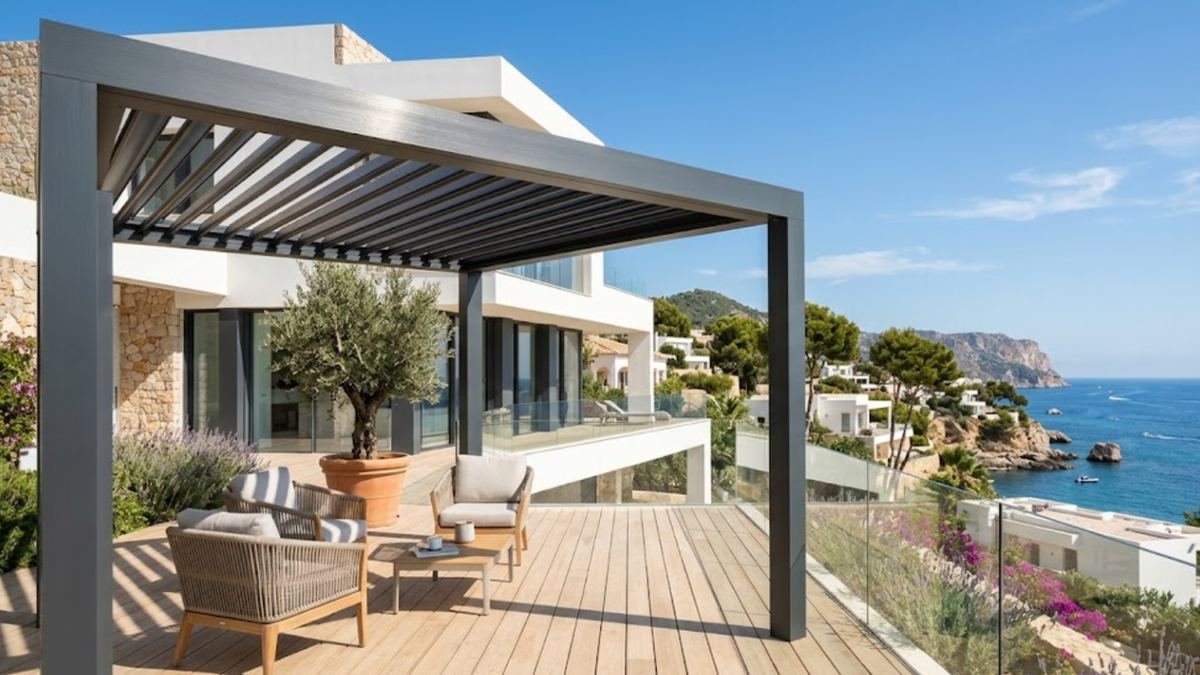
A bioclimatic pergola has a roof of adjustable louvres, usually made of aluminium. Each louvre turns on its own axis by means of an electric motor, so the whole roof behaves like a giant horizontal blind.
Depending on the angle, you get different results:
- Open louvres: light and air come in, and the terrace is ventilated.
- Tilted louvres: you control how much sun gets through and create partial shade.
- Closed louvres: the roof is almost continuous, shielding you from direct sun and rain.
The word "bioclimatic" refers to exactly this: the ability to adapt to the weather of the moment, instead of offering fixed protection.
Can a bioclimatic pergola control sun, shade and rain?
Yes, within limits. With the louvres closed, rainwater runs to the edge and is channelled through profiles with built-in drainage, which usually runs down the posts. It is a very practical solution, but let's be realistic: in strong wind or very heavy downpours some splashing can appear, and a pergola is not the same as a watertight fixed roof.
For sun, the advantage is fine control. You can let light in during the morning and partly close the louvres at midday. In winter, opening the louvres lets the sun warm the terrace during the pleasant hours.
Which orientation is best for a pergola?
Terrace orientation and the direction of the louvre axis both affect performance. These are general guidelines:
- South- or west-facing terraces get plenty of afternoon sun, just when they are used most in summer, and usually benefit from louvres that can close almost completely.
- North- or east-facing terraces get softer light and need less intense shade.
- Nearby buildings, trees or party walls can change the real situation a great deal.
That is why it is better to visit the space before recommending anything. Two terraces in the same development can need different solutions.
Can I control a pergola remotely?
Usually, yes. The louvres are driven by a motor. Depending on the model and equipment, you can operate it with a remote control, a wall switch or a phone app. That is handy if you live far from your second home and want to manage the house from a distance.
Some systems accept optional extras:
- Rain sensor: closes the louvres automatically when it detects water.
- Wind sensor: helps protect the structure in strong gusts.
- Sun or temperature sensor: adjusts the tilt to control the heat.
- LED lighting and heaters: extend use into the evening and the cooler months.
Sensors are especially useful if the property stands empty for long periods, because the louvres react on their own. Each accessory does add complexity, so choose only what you will really use.
Can I use a pergola all year round?
A well-planned bioclimatic pergola is not just for summer. In spring and autumn, with the louvres partly open, you enjoy a pleasant light. In winter, with the louvres closed and perhaps a side enclosure such as glass curtains or panels, you get an area sheltered from the wind. The key is to combine the elements according to how you want to use the space, not to install more than you need.
How do you maintain a pergola by the sea?
Aluminium stands up well, but the sea air, salt and dust call for regular attention. A sensible routine looks like this:
- Clean the louvres and gutters. Use water and mild soap, with no abrasive products. Gutters must be free of leaves and dirt so the water can flow.
- Rinse with fresh water. This helps remove the salt that settles on the profiles and screws.
- Check screws, anchors and seals. Once a year, or after storms, make sure nothing has worked loose.
- Test the motor and sensors. Move the louvres from time to time, even if you are not using the pergola, to spot noises or blockages.
- Look over the finish. If you notice patches where the coating has worn away or spots of corrosion, treat them early.
Motors and electronic components need a properly installed and protected electrical supply. If a louvre does not respond, it is better to call a professional than to force it.
What should I know about installation and structure?
The structure of a pergola must be well anchored, whether to the floor, to the wall or to both. Correct anchoring is what lets it withstand the wind without vibration or play. The installer should check the surface it will be fixed to, because not every slab or wall takes the same type of fixing.
It also matters to plan from the start where the motor cabling and the drainage will run, so the finished result looks tidy and stays accessible for future checks.
What should I ask before deciding?
Ask for the quote to state the type of structure, the aluminium finish, the drainage system, the motor, the accessories included and the installation conditions. It is also worth asking about the rules that apply to your home or development, and about community statutes if the pergola affects shared areas or the look of the facade.
If you would like to look into bioclimatic pergolas for your terrace in Torrevieja, Orihuela Costa, Guardamar or the Vega Baja, we speak Spanish, English, French, German and Norwegian. Message us on WhatsApp or call us on 671 203 728 and ask for your free quote.
Frequently asked questions
How does a bioclimatic pergola work?
The roof is made of aluminium louvres that turn on a motor. They tilt to let in sun, give shade or ventilate, and close to hold back the rain. Depending on the model, you control them with a remote, a wall switch or a phone app.
Does a bioclimatic pergola keep the rain out?
With the louvres closed, the system guides water into gutters built into the structure. In strong wind or very heavy rain some splashing can still happen, and it is not the same as a fixed roof. Ask how the specific model behaves.
Which orientation is best for a bioclimatic pergola?
It depends on how much sun your terrace gets and when you use it. South- or west-facing terraces need more shade, while north-facing ones usually want more light. The best approach is to study the terrace on site before choosing the model and louvre direction.
What maintenance does a bioclimatic pergola need?
Regular cleaning of the louvres and gutters, a check of the screws, motor and seals, and a general review before summer and after storms. Near the coast, rinse with fresh water to remove built-up salt.